
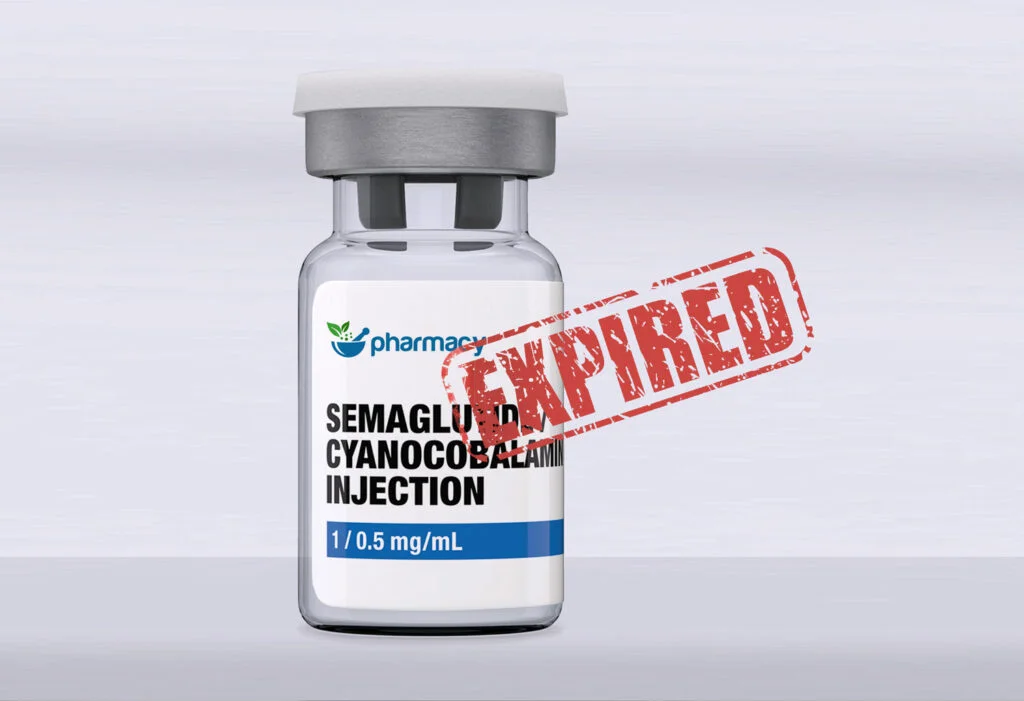
What Happens If You Use Expired Semaglutide?
Understanding Stability, Potency, and Research Implications
Semaglutide is a long-acting GLP-1 receptor agonist peptide used extensively in metabolic and endocrine research. Its complex peptide structure makes it sensitive to temperature, light, and time, all of which impact its stability and biological activity.
If you’ve ever wondered what happens if you use expired semaglutide, the short answer is this: expired peptides lose potency, stability, and reliability, compromising both research accuracy and safety.
Below, Leanify Med explains how expiration affects semaglutide’s molecular structure, why proper storage matters, and how to identify when a peptide is no longer viable.
What Does It Mean When Semaglutide Expires?
All peptides, including semaglutide, are subject to molecular degradation over time. An expiration date is determined by stability testing, which measures how long the compound maintains its purity and bioactivity under recommended storage conditions.
When semaglutide passes its expiration date, the peptide bonds that maintain its structure begin to break down, leading to:
- Loss of molecular integrity
- Reduced receptor activity (weakened GLP-1 binding)
- Decreased potency in research applications
- Higher chance of contamination if reconstituted and stored too long
Simply put, expired semaglutide can no longer be relied upon for accurate, reproducible results in laboratory studies.
What Happens If You Use Expired Compounded Semaglutide?
Using expired semaglutide may result in:
- Reduced Efficacy – The peptide’s ability to activate GLP-1 receptors decreases as it denatures.
- Inconsistent Research Data – Degraded compounds can skew experimental outcomes.
- Possible Contamination – Reconstituted (liquid) semaglutide can harbor microbial growth after its recommended shelf life.
- Loss of Purity – Peptides past their expiration often test below 95% purity, affecting reproducibility.
While expired semaglutide is not typically hazardous, it becomes scientifically unreliable and should never be used for research intended to produce verifiable data.
How to Properly Store Semaglutide
Proper storage dramatically extends the lifespan of semaglutide and maintains its research-grade quality.
Storage Tips
- Always store in a dark, temperature-controlled environment
- Avoid multiple freeze–thaw cycles
- Use sterile water or buffer for reconstitution
- Discard any solution that becomes cloudy, discolored, or particulate
How to Tell If Semaglutide Has Gone Bad
Expired or degraded compounded semaglutide often shows visible and chemical changes, such as:
- Color shift from white to off-white or yellowish tint
- Reduced solubility during reconstitution
- Formation of small clumps or particles
- pH imbalance in reconstituted solutions
If any of these signs appear, the peptide should be disposed of immediately following laboratory waste guidelines.
Why Fresh Peptides Matter in Research
The accuracy of metabolic and receptor-based studies depends heavily on using peptides that retain full activity.
At Leanify Med, every batch of semaglutide undergoes HPLC and Mass Spectrometry testing to confirm ≥99% purity and chemical integrity.
By adhering to strict GMP standards and cold-chain logistics, Leanify Med ensures that researchers receive peptides at peak molecular stability, never near expiration.
Frequently Asked Questions (FAQs)
Q1: Can expired compounded semaglutide be re-tested for purity?
A: Technically yes, but the cost and variability often make it impractical. Fresh, certified batches are always recommended.
Q2: Does refrigeration extend semaglutide’s shelf life?
A: Yes. Storing semaglutide between 2-8°C (lyophilized or reconstituted) significantly preserves stability until the expiration date.
Q3: How long can semaglutide last after mixing?
A: Once reconstituted, it remains stable for 30-45 days in the refrigerator (2-8°C).
Q4: Can I use semaglutide a few weeks after expiration?
A: It’s not advised. Even if the appearance hasn’t changed, peptide degradation occurs at a molecular level and may alter research results.
Key Takeaways
- Expired compounded semaglutide loses potency, stability, and purity.
- Do not use expired peptides, always source verified, in-date compounds.
- Proper storage (-20°C lyophilized / 2-8°C reconstituted) extends shelf life.
- Leanify Med provides fresh, high-purity semaglutide peptides with full COA verification.
Maintaining peptide integrity isn’t just best practice, it’s essential for reliable research outcomes.